“We Will Continue on the Same Path”: How Gazans Read Khalil al-Hayya’s First Speech as Hamas Leader

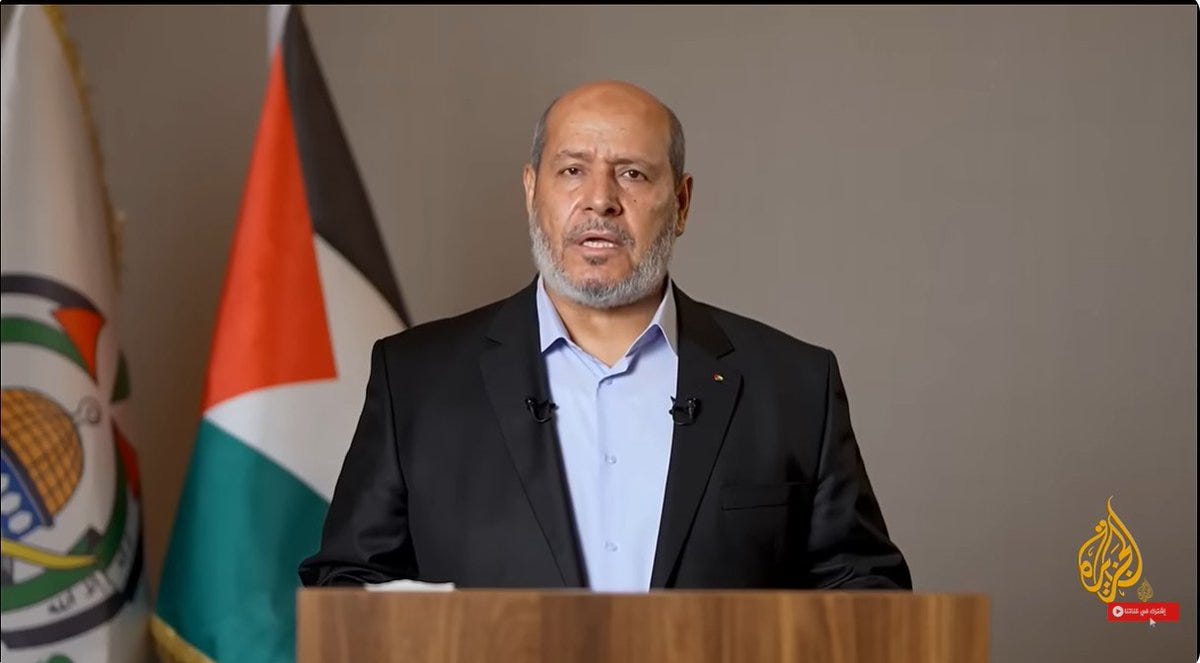
Between promises to end the war, rebuild Gaza and restore Palestinian unity, and the absence of any reckoning with the choices made on October 7 and their consequences, Gazan writers, activists and citizens saw a speech aimed more at the movement than at a society whose life has been destroyed.
In his first speech after being elected head of Hamas’s political bureau, Khalil al-Hayya delivered what may have been the most revealing line of the entire address: “We will continue on the same path and follow in the same footsteps.” To Hamas’s base, the words signalled loyalty to its slain leaders, a commitment to resistance and a refusal to retreat under pressure. But to many Gazans who listened from tents and amid the ruins of their homes, “the same path” sounded less like a promise of victory than an admission that the movement had yet to conduct a serious reckoning with the course that led Gaza to its present catastrophe.
Al-Hayya did not ignore Gaza’s suffering. On the contrary, he devoted an emotional section of the speech to its people. “You are living in tents and makeshift shelters, with the ground as your bed and the sky as your roof,” he said. He added: “Your tears are precious to us, and the pain you are living through is carried in our chests and hearts.” He placed an end to the war and a complete Israeli withdrawal at the top of Hamas’s priorities, rejected displacement and any attempt to condition reconstruction on political concessions, and called for national unity and the democratic rebuilding of the Palestine Liberation Organization.
But the problem, as a number of Gazan writers, activists and citizens saw it, was not a lack of emotion or grand national objectives. It was the gulf between those words and the questions pressing on people every day: Who bears political responsibility for the decisions that were made? What has Hamas learned from their consequences? Who will govern Gaza? What will happen to its weapons? And how can another round of war, paid for by civilians, be prevented?
An Election Decided by One Vote
Al-Hayya was elected on July 20, 2026, after Hamas had been run by an interim leadership council since Yahya Sinwar was killed in October 2024. He defeated Khaled Meshaal by a single vote, receiving 35 of the 69 ballots cast, according to press reports.
The narrow result was more than an internal organisational detail. It reflected a divide within Hamas between one camp inclined to preserve the movement’s existing political structures and regional alliances, and another that might have presented a more pragmatic face, more open to the Arab world and the West. Gazan political analyst Mohammad Shehada described al-Hayya as representing Ismail Haniyeh’s “political continuity,” occupying a position between Meshaal and Sinwar. He also noted that al-Hayya is seen within Hamas more as an administrator or bureaucratic manager than as a charismatic leader known for fiery speeches, and that his closeness to both the military wing and Iran is accompanied by extensive negotiating experience.
That distinction is essential to understanding al-Hayya. His election does not necessarily mean an absence of tactical flexibility. He has served as Hamas’s chief negotiator and demonstrated an ability to engage with mediators and US officials. The deaths of four of his sons in Israeli attacks also give him personal standing within the movement that, in Shehada’s assessment, could allow him to make difficult concessions without being accused by hardliners of surrendering Hamas’s principles.
But flexibility at the negotiating table is not the political reckoning that Hamas’s critics in Gaza are demanding. A leader can bargain over details while remaining committed to the same narrative, tools and centres of power. That is why the phrase “the same path and the same footsteps” carried such weight.
What Did al-Hayya Say?
The speech was framed in religious and mobilising language that grounded the new leadership’s legitimacy in the “covenant of the martyrs.” Al-Hayya invoked Ahmed Yassin, Abdel Aziz al-Rantisi, Ismail Haniyeh, Yahya Sinwar, Mohammed Deif and Saleh al-Arouri, insisting that Hamas would continue along the same path.
He then addressed Palestinians in Gaza, Jerusalem, the West Bank, Israel and the diaspora, placing Hamas within a history of Palestinian revolts and uprisings that culminated in what he called the “great flood.” Addressing Hamas members and the Qassam Brigades, he said they had been chosen “for a great purpose” and urged them to continue their work.
Politically, al-Hayya laid out a clear set of priorities: ending the war and securing a complete Israeli withdrawal from Gaza; pressing Israel to implement what had been agreed; restoring a dignified life and rejecting displacement; accelerating reconstruction as an “inherent right” rather than a conditional gift; securing the release of Palestinian prisoners; opening a national dialogue; and rebuilding the PLO on the basis of partnership and consensus.
On the regional front, he said Hamas would strengthen its ties across the Arab and Islamic worlds. He thanked Egypt, Qatar and Turkey for their mediation efforts, and singled out Yemen, Lebanon, Iraq and Iran because, in his words, they had “stood with us and supported us with their blood and weapons.” The speech therefore combined messages of openness towards Arab mediators with an affirmation of Hamas’s continuing relationship with Iran and its regional allies.
These were not minor themes. Rejecting displacement matters. Treating reconstruction as an unconditional right matters. And the call to rebuild the PLO democratically could hold genuine political potential if translated into practical mechanisms. Yet the speech did not explain how these principles would become decisions, or what Hamas would do differently from the previous phase.
A Speech from “October 6”
One description recurred in different forms across Gazan reactions: al-Hayya had delivered a “pre-October 7 speech.” Journalist and writer Akram Atallah said it sounded “as if nothing had happened.” Al-Hayya wanted to liberate the West Bank and Jerusalem, restore and rebuild Gaza, and lift the siege, Atallah wrote, when what was needed, in his view, was for Hamas to leave government, hand over its weapons and allow Gaza to emerge from the catastrophe.
In an article published after al-Hayya’s election, Atallah offered a broader reading of how Palestinian priorities have diverged across different places. Gaza, he wrote, is looking for a more flexible leader capable of confronting an exceptionally harsh reality, while Palestinians in the West Bank and abroad may prefer a more uncompromising leader who will continue the resistance project because its direct consequences are unfolding somewhere far from them. Al-Hayya’s election, he argued, was not welcome news for Gaza, even though al-Hayya is one of its own, because he represents the current that pushed the struggle to its furthest limits without adequately accounting for the cost.
This reading does not suggest that Gazans have necessarily abandoned their national rights or accepted the occupation. It makes a different point: those who paid the greatest human and material price have become more insistent on asking what the outcome was. Intentions and slogans are no longer enough, because people do not live inside political communiqués. They live with what political decisions leave behind on their bodies, their homes and their children’s futures.
Resistance Is Not Above Accountability
Political science professor Ibrahim Abrash drew attention to the contradiction between al-Hayya’s call to activate resistance in the West Bank and the outcome of Hamas’s model of resistance in Gaza. What form of resistance does Hamas intend to bring to the West Bank, he asked? Will it take the form of rockets and tunnels? And are West Bank residents prepared for that strategy and its cost?
He summarised his position plainly: “We are not rejecting the principle of resisting the occupation. We are rejecting contempt for people’s intelligence and the attempt to repeat the same failed approach.”
The statement matters because it breaks a binary often used to close down Palestinian debate: either endorse Hamas’s approach in full, or reject resistance and serve the occupation. In reality, a Palestinian can uphold the right to resist occupation while also rejecting one faction’s monopoly over how resistance is defined, which methods it uses, when it acts and what price it imposes. Palestinians can hold Israel primarily and directly responsible for killing civilians and destroying Gaza without surrendering their right to hold Palestinian leaders accountable for decisions made in their name and without their participation.
Internal accountability does not absolve Israel, just as Israel’s crimes do not grant any Palestinian leadership immunity from criticism. Holding both truths at once is not a contradiction; it is a condition for building a more ethical Palestinian politics, one better able to protect its people.
The Missing Words: “We Were Wrong”
A widely shared post by a Gazan citizen distilled the reaction into one line: “Al-Hayya’s speech was the same old refrain, and ordinary people are the ones paying the price.” The writer said al-Hayya should have told the public, “We were wrong,” and accepted responsibility for Hamas’s policies and its determination to remain in power. In Gazan colloquial Arabic, the post concluded: “Gaza needs actions that will save its people, not speeches that add to their pain.”
“We were wrong” may have been the phrase Hamas’s critics most wanted to hear and did not. They were not asking for a hollow confession to please Hamas’s opponents, nor for the movement to adopt an Israeli narrative used to justify the destruction of Gazan society. They were asking for an acknowledgement that political and military decisions must be judged not only by their intentions or their ability to command global attention, but by what they achieve for the people in whose name they are made and by the consequences they leave behind.
Al-Hayya’s speech, however, offered no review of the October 7 decision, no assessment of its objectives and consequences, and no explanation of how the decision was made within Hamas. Nor did it acknowledge that the movement’s continued rule by force, after many years without elections, had created a crisis of legitimacy that predated the war and deepened during it. He described Gaza’s pain, but did not place it within a chain of causes, choices and responsibilities.
That is the difference between empathy and accountability. A leader can tell people he shares their pain. Political responsibility begins when he explains what will change because of it.
“The People of Gaza Do Not Want Speeches”
Writer Jihad Malaka described the address as “a political coma and denial rising over Gaza’s ruins.” Al-Hayya, he wrote, sent greetings across the Palestinian map and promised to restore “the beautiful, radiant Gaza we once knew,” but did not confront the scale of the transformation that had overtaken the enclave or his movement’s responsibility for it.
“The people of Gaza do not want grand speeches,” Malaka wrote. They want a roof to protect them from the rain, food to eat, and time to catch their breath and bury their dead. He called on Hamas to leave government, hand its weapons to a unified national authority and release its hold over Gaza’s fate so that what remains can be saved.
Palestinians may disagree profoundly over the demand to surrender weapons, particularly under continuing occupation and while the Israeli military maintains its attacks and control. But the significance of this view is that it shifts the centre of the debate from the movement’s right to survive to society’s right to be saved. The question is no longer only how Hamas preserves its weapons and influence, but what political and security arrangement can prevent Gaza from once again becoming an open battlefield.
Does Retaining Its Weapons Mean the Project Has Survived?
Writer Maysa Abu Ghannam argued that speeches by Hamas leaders have become more like media messages intended to preserve the movement’s place in public consciousness than expressions of a political force capable of advancing a workable project. The continued presence of armed groups, she wrote, “does not necessarily amount to political power or popular legitimacy,” because weapons alone do not confer political representation.
Her argument goes to the heart of the crisis al-Hayya faces. Hamas can point to the survival of its fighters and their capacity to operate as proof that Israel has not achieved all of its objectives. But organisational survival is not the same as national success. An organisation may survive while the society in which it arose collapses; it may retain its weapons while losing the ability to govern, persuade or build a national coalition.
That is why it was not enough for al-Hayya to call for Palestinian unity or the rebuilding of the PLO. He needed to answer whether Hamas would genuinely submit to shared national institutions and the results of free elections. Would it accept that it cannot make decisions of war and peace alone? Would it place its military wing within an agreed national framework, or would “partnership” continue to mean that others join Hamas’s project on Hamas’s terms?
What the Speech Left Unsaid
Sometimes the silences in a speech reveal more than its words. Al-Hayya’s address offered no clear answers on several questions that will determine Gaza’s future:
First, it offered no political or moral review of the October 7 decision, and did not consider whether its objectives were proportionate to the consequences borne by Gazan society.
Second, it set out no practical position on the future of Hamas’s rule, who should govern Gaza, or what safeguards could prevent a return to one-faction rule.
Third, it offered no clear vision for the future of Hamas’s weapons, their relationship to a unified national decision-making process, or how Palestinians could be protected from occupation without leaving the decision to go to war in the hands of a single organisation.
Fourth, it did not explain how reconstruction would be carried out, who would oversee it, how funds would be raised and managed, or what concessions or arrangements would be required to open Gaza and ensure that it is not destroyed again.
Fifth, it called for national dialogue and reform of the PLO, but offered no timetable, mechanism or electoral commitment that could turn a familiar slogan into a measurable process.
Hamas does not hold all the answers to these questions. The Palestinian Authority, other Palestinian factions, Arab mediators and the international community also bear responsibility, while Israel remains the power imposing occupation, siege and destruction. But al-Hayya was addressing the public as the new leader of a movement that governed Gaza and made the decision to go to war. The moment demanded more than shifting responsibility outward.
It is also important to note that al-Hayya is not personally untouched by loss. Four of his sons and other relatives have been killed in Israeli attacks, and he comes from the Gaza he addressed. But shared pain does not erase the difference between a citizen who has no say in the decision to go to war and a leader who helps make it. Personal sacrifice may give al-Hayya credibility within his movement, but it does not exempt him from giving the public a political accounting.
The sheer number of critical voices emerging from Gaza points to a political trend that cannot be ignored: the legitimacy of resistance can no longer be separated from its ability to protect society and deliver outcomes that can be defended. Leadership can no longer be measured only by its ability to endure or survive, but by its capacity to learn, step back and change its methods when the cost exceeds what people can bear.
Al-Hayya’s Real Test
Al-Hayya’s speech may have been an attempt to address two constituencies that are difficult to satisfy at the same time: Hamas members who wanted a reaffirmation of continuity and a refusal to surrender, and Gazans who wanted a tangible end to war, hunger and displacement. He therefore used language that was firm on principle but relatively flexible on politics: resistance on one side, and negotiations, unity and reconstruction on the other.
But the real test will not be his ability to combine those words. It will lie in the decisions he makes when the movement’s interests conflict with Gaza’s need for survival. Will he accept an agreement that reduces Hamas’s power if it opens the way to reconstruction and protects civilians? Will he place weapons and military decision-making within a national framework? Will he allow Gazans to choose who governs them? And can he admit that an approach has failed when its results show failure, even if that approach is associated with leaders Hamas regards as martyrs and symbols?
Al-Hayya said he knows Gaza and that Gaza knows him. But knowing Gaza today means more than knowing its history, its patience and its capacity to endure. It means listening to its anger, fear and exhaustion, and recognising its right not to be asked endlessly to prove its steadfastness through death.
After everything Gaza has lost, it is no longer enough for a leader to say he shares its pain or to promise the return of “beautiful Gaza.” The question Gaza’s critics put to al-Hayya was both simpler and harder: What have you learned from what happened? And what will change so that Gaza is not asked once again to pay the same price in the name of the same path?
Reference Sources
· Reuters, “Hamas Names Khalil al-Hayya as New Overall Leader,” July 20, 2026. (Link)
· Al Jazeera Arabic, “Khalil al-Hayya: We Will Follow Our Leaders’ Path; Restoring a Dignified Life in Gaza Is Our Priority,” July 22, 2026. (Link)
· Al Jazeera English, “What Does Khalil al-Hayya’s Election Win Mean for Gaza?” July 20, 2026. (Link)
· Akram Atallah, “Hamas’s Leader...!” July 21, 2026. (Link)